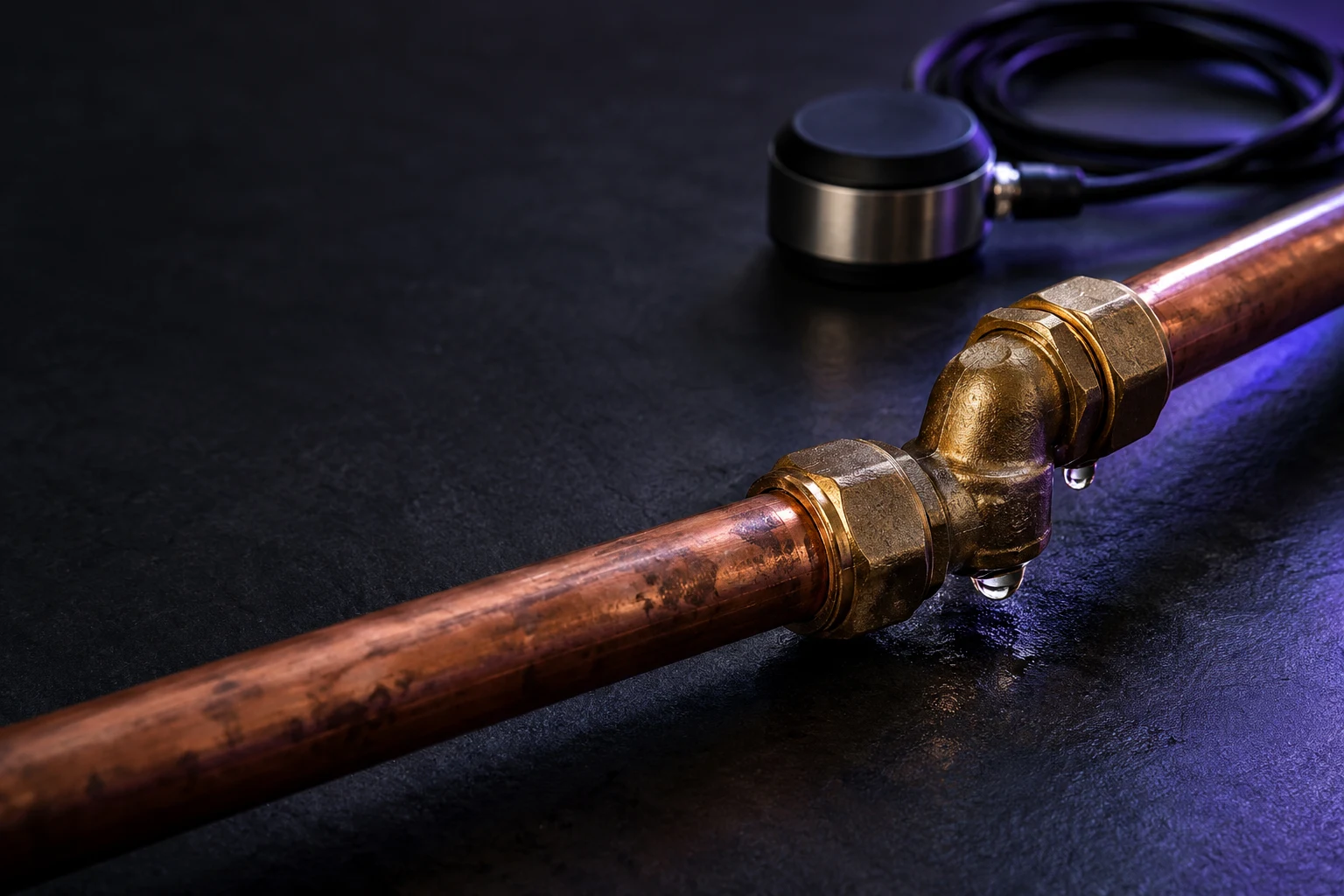
Hidden leak?
Let’s find it.
Water in the ceiling. Pressure dropping. A meter that keeps moving.
Leak Lab investigates the source and completes the agreed plumbing repair.
Clear scope before the visit
Detection, access & agreed repair
Written Trace & Access report
12-month workmanship warranty
£100 deposit, deducted.
£1,600 remaining balance.
- Investigation & specialist leak detection
- Necessary access & plumbing repair
- Parts, testing & Trace & Access report
- 12-month workmanship warranty
Decorative and remedial reinstatement excluded. Commercial and wider shared-system work quoted separately.
See everything includedMore than a
damp patch.
A hidden water leak can start with something small: a mark that keeps returning, a floor that feels warm or a change in the water bill. The visible damage may be a long way from the failed pipe.
Leak Lab investigates those signs. We look at the system and its history, use suitable specialist checks and explain the evidence before access and repair are agreed.
Meet the Leak Lab approach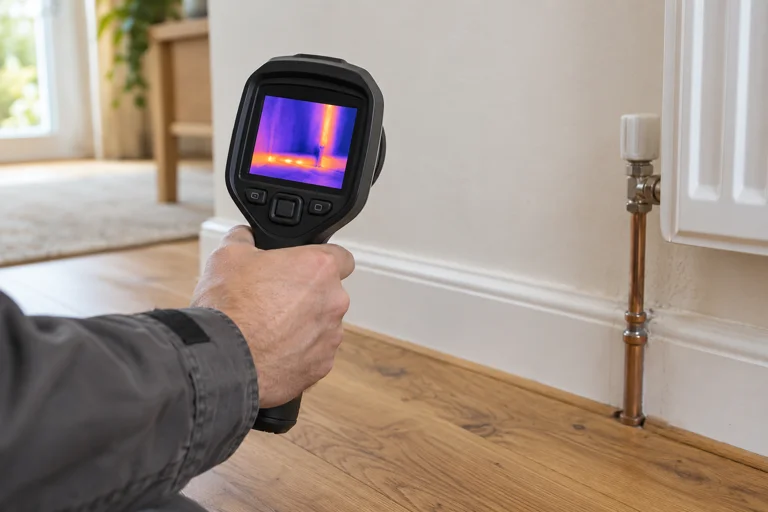
The right test for your leak.
Thermal imaging, acoustic listening, tracer gas and pressure testing each answer different questions. We choose methods that suit the pipework, construction and access.
Explore our detection methodsInside, outside
and beneath the floor.
Specialist investigation for concealed domestic plumbing, heating circuits and private water supplies.
Hidden leak detection
Investigate concealed pipes with a clear reason for each test.
Explore LEAK LABCeiling leak detection
Trace the cause of overhead water marks.
Explore LEAK LABCentral heating leak detection
Make sense of water loss from the heating circuit.
Explore LEAK LABMains water leak detection
Trace possible losses along the private incoming supply.
Explore LEAK LABUnderground leak detection
Build an access plan for pipework below ground.
Explore LEAK LABUnderfloor heating leak detection
Investigate water-based heating loops beneath the floor.
ExploreThe stain shows
where water arrived.
A hidden leak in a ceiling may come from a bathroom connection, concealed supply, heating pipe or an area in another flat. Water can travel along joists and pipe penetrations before it leaves a visible mark.
We consider the timing, the fittings and spaces above, and the checks that can connect the symptom to a source. Access to an upstairs room or neighbouring flat may need to be arranged before the investigation.
What helps a ceiling-leak enquiry?
- The room and position of the mark
- When it appeared and whether it is growing
- Any link with showering, heating or other water use
- The rooms or flat above and who can allow entry
- Photographs and details of earlier repairs
Keep clear of a sagging ceiling or water near electrics. Use appropriate urgent help for an immediate hazard; the website cannot provide an emergency response.
Read about ceiling leak detectionYou do not need
to know which pipe.
Describe what has changed. These are useful reasons to investigate, with several possible causes to consider.
Pressure keeps falling
A heating pressure drop may involve concealed pipework, an accessible joint or an appliance issue. Previous boiler findings and a reading history help focus the checks.
Understand this signDamp keeps returning
Moisture readings and the pattern around water use or weather help distinguish a possible plumbing leak from other causes.
Understand this signThe meter keeps moving
Automatic consumption and shared use need to be considered before unexplained movement is treated as a private-supply leak.
Understand this signA floor is wet or warm
Water and heat can spread through a floor. Construction details and suitable system checks help establish where further investigation is useful.
Understand this signWater appears after a shower
The delay after use can help separate supply connections, wastes and enclosure-related routes. The repair needs to address the supported cause.
Understand this signThe garden stays wet
Persistent wet ground may come from a private pipe, drainage or another source. The known supply route and dry-weather pattern are useful context.
Understand this signFind it.
Reach it.
Repair it.
£1,700 including applicable tax
£100 deposit deducted from the total.
£1,600 remaining balance.
- Investigation of the reported leak
- Specialist detection and pipe tracing
- Necessary access or excavation
- The agreed plumbing repair
- Repair parts and materials
- Appropriate testing after the work
- A written Trace & Access report
- 12-month workmanship warranty
There is no hourly surcharge solely because the agreed residential work takes longer. Additional unrelated work or a changed instruction must still be agreed.
What is outside the package?
Decorative and remedial reinstatement is excluded, including the restoration of plaster, paint, floor coverings, paving and landscaping. Commercial and wider shared-system work receives a separate quotation.
Evidence first.
A repair plan
you understand.
Specialist detection should make the next decision clearer. We explain useful findings, access restrictions and uncertainty so you can understand the proposed work.
What happens during the investigationUnderstand the problem
Review the observations, accessible fittings and previous work. Establish which system and instruction the visit concerns.
Locate with suitable methods
Use appropriate testing and tracing to narrow the suspect route. No instrument guarantees a result in every condition.
Agree access and repair
Discuss the necessary opening or excavation, then carry out the agreed plumbing repair with its parts and materials.
Test and document the work
Complete suitable checks and the Trace & Access report. Keep the record with the 12-month workmanship warranty details.
A clear record
of what was found.
The report brings the reported concern, relevant checks, access and agreed plumbing work into one record. It should distinguish observations from conclusions and explain important limitations.
If an insurer or managing agent needs particular information, tell us before the visit. Your insurer decides authorisation, cover and reimbursement; a report does not promise claim approval.
What the report recordsFind your town.
Tell us the signs.
Searching for “leak detection near me”? Explore our individual town pages across Berkshire, Buckinghamshire, Surrey, selected London locations, north Hampshire, Hertfordshire, Oxfordshire and Bedfordshire.
Each landing page shows postcode districts, nearby places and relevant investigation information. Your full postcode and access details are needed to confirm coverage and visit arrangements.
Search the coverage directoryA page for your area.
Start with a town, then explore its local coverage and contact options.
Before you arrange
an investigation.
How do you plan an investigation?
We combine leak detection with the agreed plumbing repair. Our approach uses the property history, suitable tests and a clear agreed scope to guide the work.
What does the £1,700 include?
Investigation, specialist detection and tracing, necessary access or excavation, the agreed plumbing repair, parts, materials, suitable testing, a Trace & Access report and a 12-month workmanship warranty. The total includes applicable tax.
Is the deposit an extra charge?
No. The £100 deposit is deducted from £1,700, leaving £1,600. Booking terms and payment timing must be confirmed before commitment.
What if the work takes longer?
There is no hourly surcharge solely because the agreed residential work takes longer. A changed instruction or unrelated additional work still needs a separate agreement.
Are floors, walls and paving put back?
Decorative and remedial reinstatement is excluded. Necessary access or excavation is included in the agreed plumbing scope; repairing finishes requires separate arrangements.
Does the package apply to businesses or shared systems?
Commercial and wider shared-system work is scoped and quoted separately. Explain the system and properties involved before assuming the residential package applies.
Is detection guaranteed?
No method guarantees a result in every installation or condition. Findings, access restrictions and uncertainty should be explained before the next step is agreed.
Will an insurer accept the report?
Your insurer decides how the policy applies and what it needs. Confirm authorisation and reporting requirements directly before booking. A report is not a promise of claim approval.
Understand your
next step.
Pressure loss: what to record first
Build a useful heating history before assuming a hidden pipe has failed.
Explore FIELD NOTESWorking back from water overhead
The visible mark may be the end of a longer route.
Explore FIELD NOTESTrace, access and repair: the boundaries
Understand the difference between locating a source and restoring a finish.
Explore